Baroque art: drama, light, and spectacle
Historical context: art as power, faith, emotion, and prestige in the Baroque era
The Baroque period developed in Europe around the end of the sixteenth century and continued throughout much of the seventeenth century. It followed the Renaissance and Mannerism, introducing new ways of creating dramatic, emotional, and visually powerful works of art.
The seventeenth century was marked by religious conflict, political change, and competition between European states. The Protestant Reformation had divided Western Christianity, and the Catholic Church responded with the Catholic Reformation, also known as the Counter-Reformation.
The Council of Trent (1545–1563) reaffirmed Catholic doctrine and addressed the role of religious art. Religious images were expected to communicate Christian teachings clearly, inspire faith, and encourage devotion. As a result, the Catholic Church became an important patron of artists, commissioning paintings, sculptures, and elaborate church decorations designed to engage viewers emotionally.
Baroque art was also used to express power and prestige. Popes, kings, and wealthy families commissioned portraits, monuments, palace decorations, and impressive buildings. Rome became a major centre of Baroque painting, sculpture, and architecture, while Spain developed a distinctive artistic tradition supported by the monarchy and the Catholic Church.

Main Characteristics of Baroque Art
Baroque art did not have one uniform style. Some artists used dramatic lighting and realistic figures, while others preferred idealised forms, complex compositions, and grand architectural designs. Despite these differences, many Baroque artists aimed to make their works visually powerful and emotionally engaging.
Baroque artists wanted to engage viewers emotionally. Instead of presenting calm, balanced scenes, they often depicted dramatic moments filled with movement, tension, and strong emotions. Important characteristics include:
Dramatic Lighting
Strong contrasts between light and darkness emphasize important figures and actions. Light guides the viewer's attention and can increase the emotional impact of a scene.
Movement and Dynamism
Figures twist, reach, and move, creating a sense of energy. Artists often capture a moment of action rather than showing figures in calm, static poses.
Emotional Intensity
Artists depict powerful feelings such as fear, devotion, suffering, and determination. These emotions help viewers connect with the people and events represented.
Realism
Figures and objects often appear lifelike, with attention to physical details. Realistic faces, bodies, clothing, and surroundings can make scenes feel immediate and believable.
Theatrical Composition
Scenes are arranged to create a dramatic effect, as if the viewer were witnessing an event. Artists carefully organise figures, gestures, light, and space to direct attention and heighten tension.
Monumentality
Paintings, sculptures, and buildings often create a sense of grandeur and spectacle. Large-scale works and impressive designs could inspire awe and communicate the power of religious institutions or wealthy patrons.
Baroque Art in Italy
Caravaggio (1571–1610)
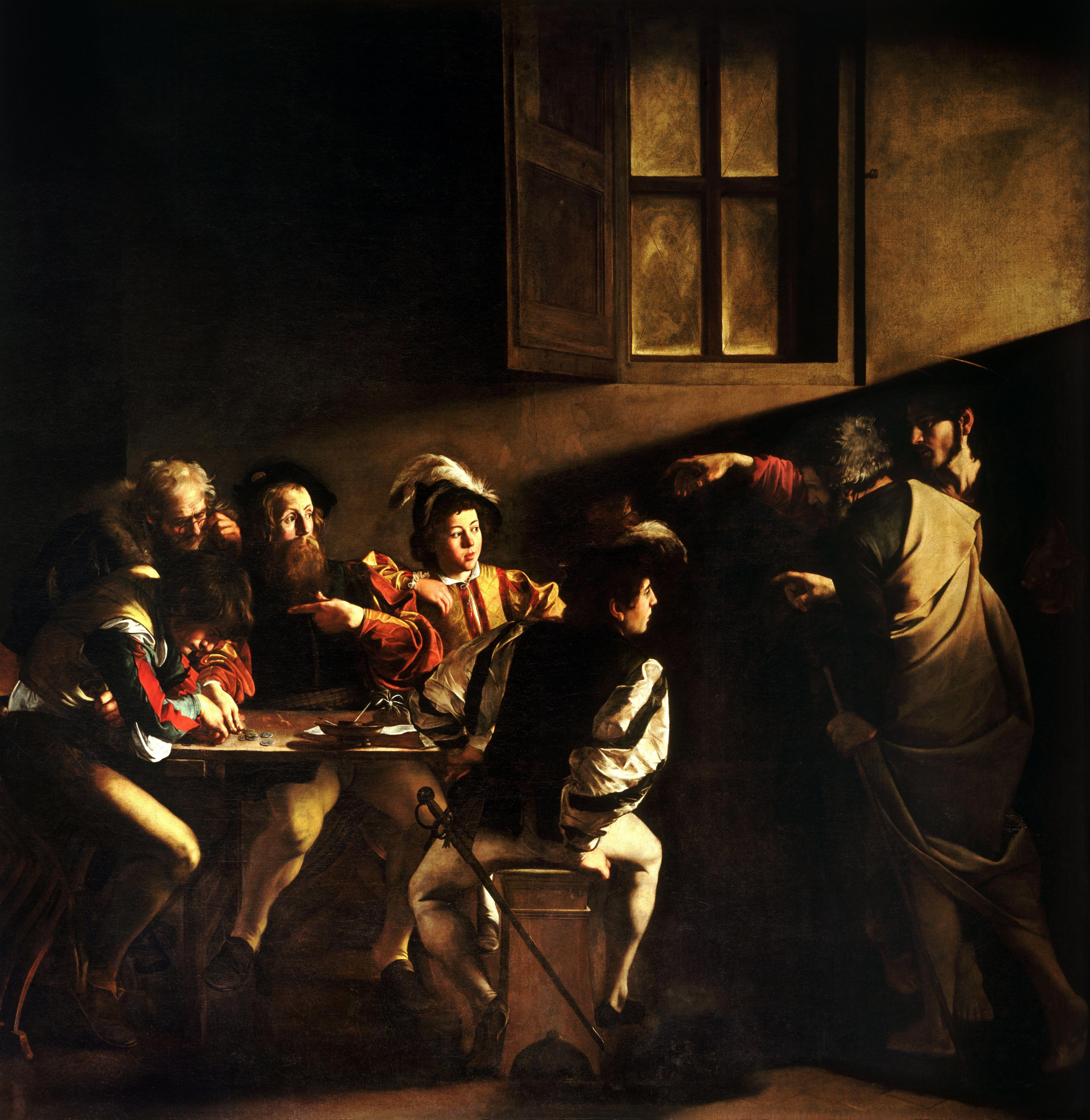
Michelangelo Merisi da Caravaggio was one of the most influential painters of the Baroque period. He became famous for his realistic figures, dramatic compositions, and powerful contrasts between light and darkness.
His use of dramatic light is often called tenebrism, a technique in which figures emerge from deep shadows into intense areas of light. This directs the viewer's attention toward the most important parts of a scene.
Caravaggio often represented biblical figures as ordinary people. Instead of idealizing them, he gave them realistic faces, bodies, and clothing. This made religious stories appear immediate and human.
The Calling of Saint Matthew (1599–1600)
This painting depicts the moment when Jesus calls Matthew to follow him. Jesus enters a room where men are gathered around a table. A beam of light crosses the dark interior and draws attention to the figures.
The dramatic lighting emphasizes the moment of spiritual transformation. The setting resembles an ordinary room, making the biblical event feel as though it could happen in the viewer's own world.
Annibale Carracci (1560–1609)
Annibale Carracci helped establish an important direction in Baroque painting. He studied the art of the Renaissance, particularly its balanced compositions, idealized figures, and careful organization.
Rather than rejecting Renaissance traditions, Carracci combined classical ideals with the energy and movement associated with the emerging Baroque style.
The Farnese Palace Gallery Ceiling (1597–1601)
Carracci and his workshop decorated the ceiling of the Farnese Palace in Rome with mythological scenes. The complex composition creates the illusion of a richly decorated architectural space filled with figures and framed paintings.
The work demonstrates how Baroque artists combined classical mythology, illusionistic painting, and monumental decoration to create an impressive visual experience.
Artemisia Gentileschi (1593–c. 1654)
Artemisia Gentileschi was one of the most accomplished painters of the Baroque period. She worked in a world in which professional artistic careers were dominated by men, yet she established an independent career and became a respected painter.
Her work is known for its dramatic lighting, strong compositions, realistic figures, and intense emotional expression. She frequently painted biblical and historical women, presenting them as active participants in moments of conflict and decision.
Gentileschi was influenced by Caravaggio's dramatic use of light and realism, but she developed her own powerful approach to storytelling.
Judith Beheading Holofernes (c. 1612–1613; another version c. 1620)
The painting depicts a story from the biblical Book of Judith. Judith, a Jewish widow, enters the camp of the Assyrian general Holofernes and kills him to save her people. Her maidservant assists her.
Gentileschi chooses the most dramatic moment of the story. Judith and her maidservant are physically engaged in the action, while Holofernes struggles beneath them. The figures occupy much of the picture, making the scene feel immediate and intense.
The strong contrast between light and darkness emphasizes the bodies, gestures, and expressions. The realistic treatment of the figures and the force of the action are characteristic of Baroque painting.
The painting also demonstrates Gentileschi's interest in representing women as determined and capable figures rather than simply as passive subjects.
Gian Lorenzo Bernini (1598–1680)
Gian Lorenzo Bernini was a leading sculptor and architect of the Italian Baroque. He worked for powerful patrons, including popes, and helped shape the appearance of Rome during the 17th century.
Bernini's sculptures often capture a dramatic moment in an unfolding action. He used the human body, facial expressions, flowing drapery, and carefully arranged compositions to create emotional intensity.
David (1623–1624)
Bernini represents David at the moment he prepares to throw a stone at Goliath. Unlike earlier Renaissance representations that often show David standing calmly before or after the action, Bernini captures him in the middle of movement.
David twists his body and concentrates on his target. The viewer can almost imagine the movement continuing beyond the sculpture.
The work illustrates the Baroque interest in action, tension, and the relationship between the artwork and the viewer's space.
The Ecstasy of Saint Teresa (1647–1652)
This sculptural group depicts the religious experience of Saint Teresa of Ávila. An angel stands before her as she experiences a moment of spiritual ecstasy.
Bernini combines sculpture, architecture, and lighting to create a theatrical effect. The figures appear to occupy a dramatic scene rather than a simple, isolated sculpture.
The work demonstrates how Baroque art could unite different artistic forms to create an emotionally powerful religious experience.
Saint Peter's Square, Vatican City
Bernini designed the great colonnades surrounding Saint Peter's Square. Their curved arrangement embraces the open space in front of the basilica and creates a monumental setting for religious ceremonies.
The project demonstrates the Baroque interest in architecture as an experience involving movement, space, and the viewer.
Francesco Borromini (1599–1667)
Francesco Borromini was an important Baroque architect known for his inventive use of architectural forms.
While Renaissance architecture often emphasized clear geometric order and balanced proportions, Borromini experimented with curved walls, complex spatial arrangements, and unusual combinations of shapes.
San Carlo alle Quattro Fontane (begun in 1638)
This church in Rome is known for its compact space and dynamic architectural design. Its curved surfaces and complex geometry create a sense of movement, even though the building itself is stationary.
Borromini's work demonstrates that Baroque architecture was not simply about large buildings or elaborate decoration. It could also transform a relatively small space through inventive design.
Baroque Art in Spain
Spanish Baroque art developed in a strongly Catholic society, where religious institutions and the monarchy were important patrons. Religious painting often emphasized devotion, realism, and emotional intensity.
However, Spanish Baroque artists also produced portraits and scenes of court life. These works provide insight into the social hierarchy and political culture of the Spanish monarchy.
Diego Velázquez (1599–1660)
Diego Velázquez was one of the most important Spanish painters of the 17th century. He became court painter to King Philip IV and produced portraits of the royal family, court officials, and other figures.
Velázquez was admired for his ability to represent people and objects convincingly. His brushwork, treatment of light, and attention to the relationships between figures and their surroundings helped make his paintings remarkably lifelike.
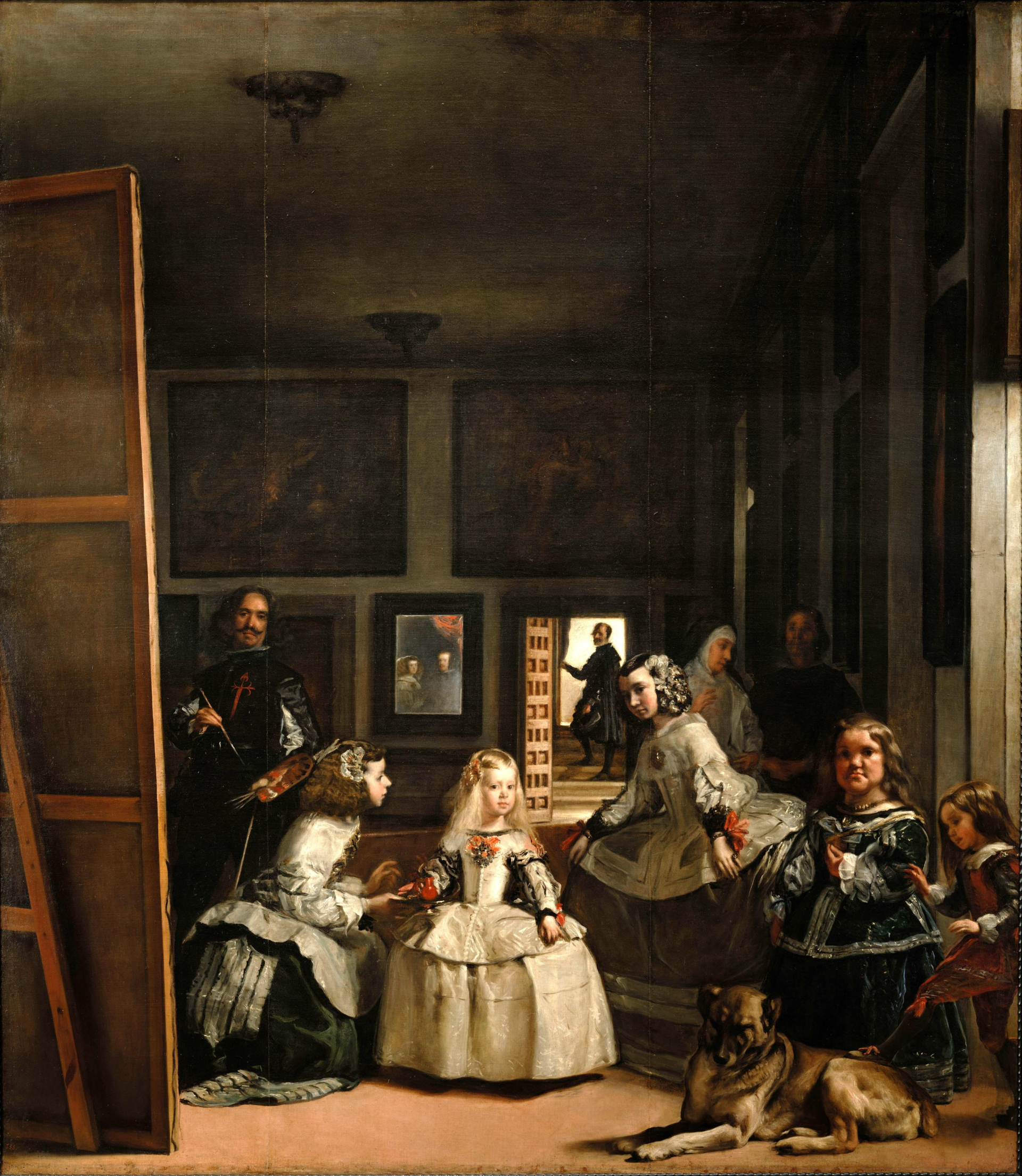
Las Meninas (1656)
Las Meninas depicts the young Infanta Margarita surrounded by her attendants, known as las meninas. Velázquez himself appears on the left side of the painting, standing before a large canvas.
In the background, a mirror reflects the king and queen, suggesting that they are standing somewhere in front of the painted scene.
The painting raises questions about who is looking at whom and what is happening outside the picture. The viewer becomes part of this complex arrangement of gazes.
Las Meninas is important because it is more than a royal portrait. It explores the relationship between the artist, the subjects, and the viewer, while also demonstrating Velázquez's mastery of space, light, and realistic representation.
Additional Context: The Dutch Golden Age
While Baroque art in Italy and Spain often emphasized religious drama, monumental architecture, and powerful patrons, the Dutch Republic developed a distinctive artistic culture during the 17th century.
The Dutch Republic was a largely Protestant society with a prosperous urban population. Merchants, professionals, and private citizens became important buyers of art. As a result, many Dutch artists created paintings for homes rather than for churches or royal palaces.
Popular subjects included portraits, landscapes, still lifes, and scenes of everyday life. These paintings often demonstrated close observation of the world, careful attention to light, and an appreciation of ordinary objects and activities.
This artistic development is known as the Dutch Golden Age. It belongs to the broader European art of the 17th century, although its subjects and markets differed in important ways from those of Catholic Italy and Spain.
Johannes Vermeer (1632–1675)
Johannes Vermeer was a Dutch painter best known for his carefully composed domestic scenes. His paintings often depict people performing ordinary activities in quiet interiors.
Vermeer paid particular attention to natural light, the textures of fabrics and objects, and the relationship between figures and architectural space. His paintings frequently create a sense of stillness and concentration.
The Milkmaid (c. 1660)
The painting depicts a woman carefully pouring milk from a jug into a container. She stands in a simple interior, surrounded by everyday objects.
Light enters from a window on the left and illuminates the woman, the bread, the pottery, and the table. Vermeer uses subtle differences in light and texture to make ordinary objects appear vivid and tangible.
Unlike Caravaggio's The Calling of Saint Matthew, which uses dramatic lighting to emphasize a moment of religious transformation, Vermeer's painting presents a quiet domestic activity. The light does not create a theatrical climax; instead, it helps us observe the scene closely.
Both artists demonstrate the importance of light in 17th-century painting, but they use it for different purposes.
Vermeer is therefore a useful comparison when studying Baroque art. His work shows that 17th-century European painting was not uniform: artists responded to different religious traditions, social environments, and audiences.
Rembrandt van Rijn (1606–1669)
Rembrandt van Rijn was one of the most important Dutch painters of the 17th century. He was known for his expressive figures, dramatic use of light and shadow, and ability to convey human emotion.
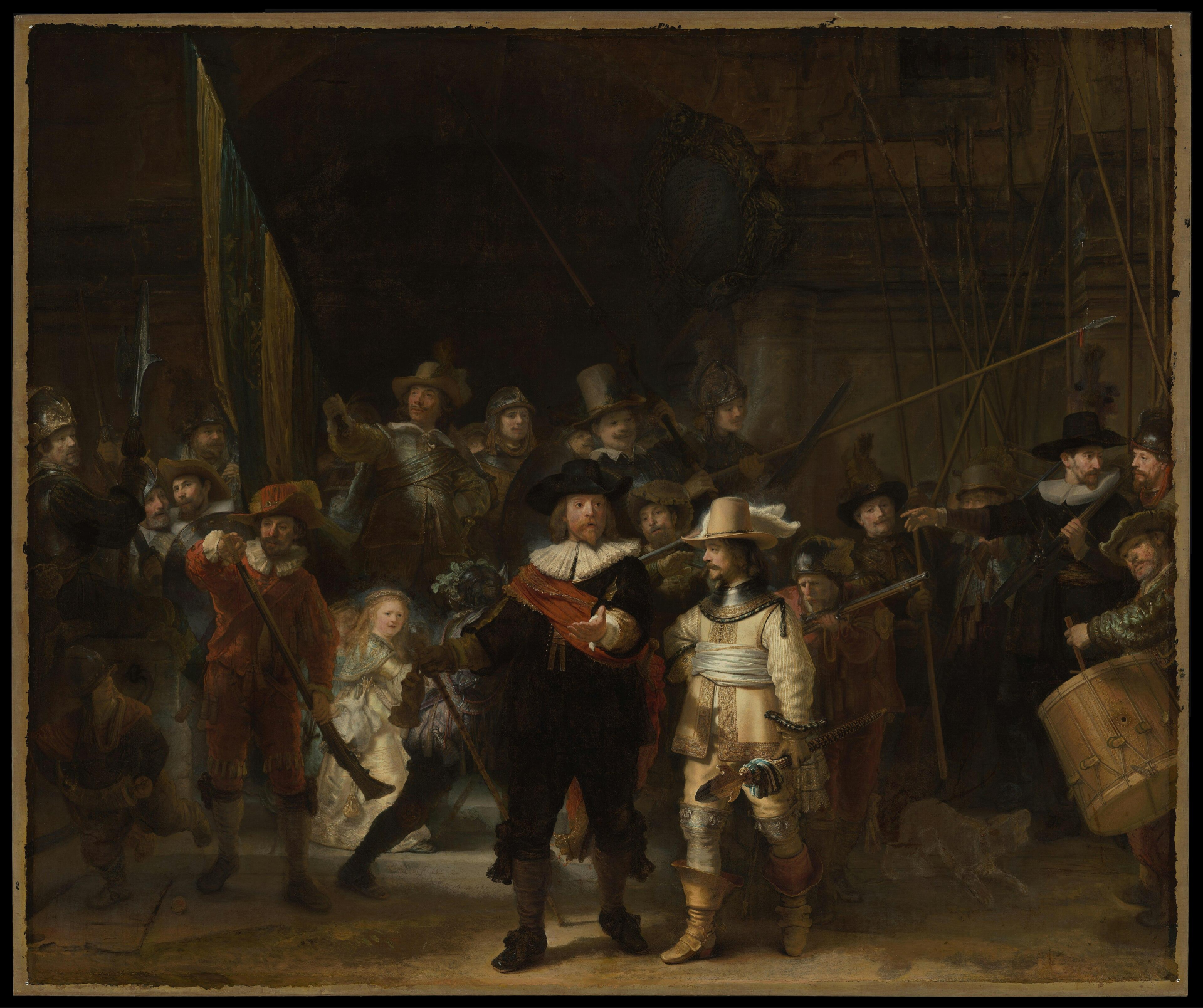
The Night Watch (1642)
The Night Watch is a large group portrait of a civic guard company. Rather than arranging the figures in a static row, Rembrandt creates a lively composition in which the guards appear to be preparing to move. Contrasts of light and shadow draw attention to selected figures and give the scene a sense of movement and depth.
The Anatomy Lesson of Dr. Nicolaes Tulp (1632)
This painting depicts a public anatomy demonstration attended by members of a surgeons' guild. It combines group portraiture with an event from professional life, illustrating the variety of subjects commissioned by Dutch patrons.
Rembrandt and Vermeer demonstrate two different strengths of Dutch painting. Vermeer concentrated on quiet domestic interiors and the effects of natural light, while Rembrandt explored human expression, dramatic lighting, and dynamic group compositions. Together, their works show the diversity of the Dutch Golden Age.
Key terms
Baroque: An artistic style associated with drama, movement, emotional intensity, and theatrical effects, especially during the 17th century.
Catholic Reformation / Counter-Reformation: The Catholic Church's response to the Protestant Reformation, involving efforts to reaffirm Catholic teachings and strengthen the Church.
Chiaroscuro: The use of light and shadow to create the impression of volume, depth, and three-dimensional form in a painting.
Tenebrism: A dramatic use of light and darkness in which brightly illuminated figures or objects emerge from deep shadows.
Patronage: Financial or material support given to artists by individuals or institutions that commission artworks.
Illusionism: The use of artistic techniques to create the impression that painted forms or spaces are real.
Dutch Golden Age: A period of flourishing artistic and economic activity in the Dutch Republic during the 17th century.
Genre painting: Painting that depicts scenes of everyday life.
Create Your Own Website With Webador