Post-Impressionism, Symbolism and Art Nouveau
Historical context
During the second half of the nineteenth century, artists began to question the aims and methods of Impressionism. Impressionists had explored the effects of light and color and the changing appearance of the visible world. However, some artists wanted to go further. They sought stronger structure, more expressive color, or ways to communicate ideas and emotions that could not be explained through direct observation alone.
At the same time, modern cities were expanding, industrial production was changing everyday life, and new technologies influenced the way people experienced the world. Artists increasingly searched for new forms of expression rather than relying on established academic traditions.
Several important developments emerged during this period. Post-Impressionism describes different artistic approaches that developed beyond Impressionism. Symbolism emphasized imagination, dreams, spiritual ideas, and meanings that could not always be expressed directly. Art Nouveau introduced a new decorative style, using flowing lines, plant-inspired forms, and an integration of art with architecture and everyday objects.
These were not identical movements, and their artists did not all share the same goals. Together, however, they helped prepare the way for modern art.
Post-Impressionism
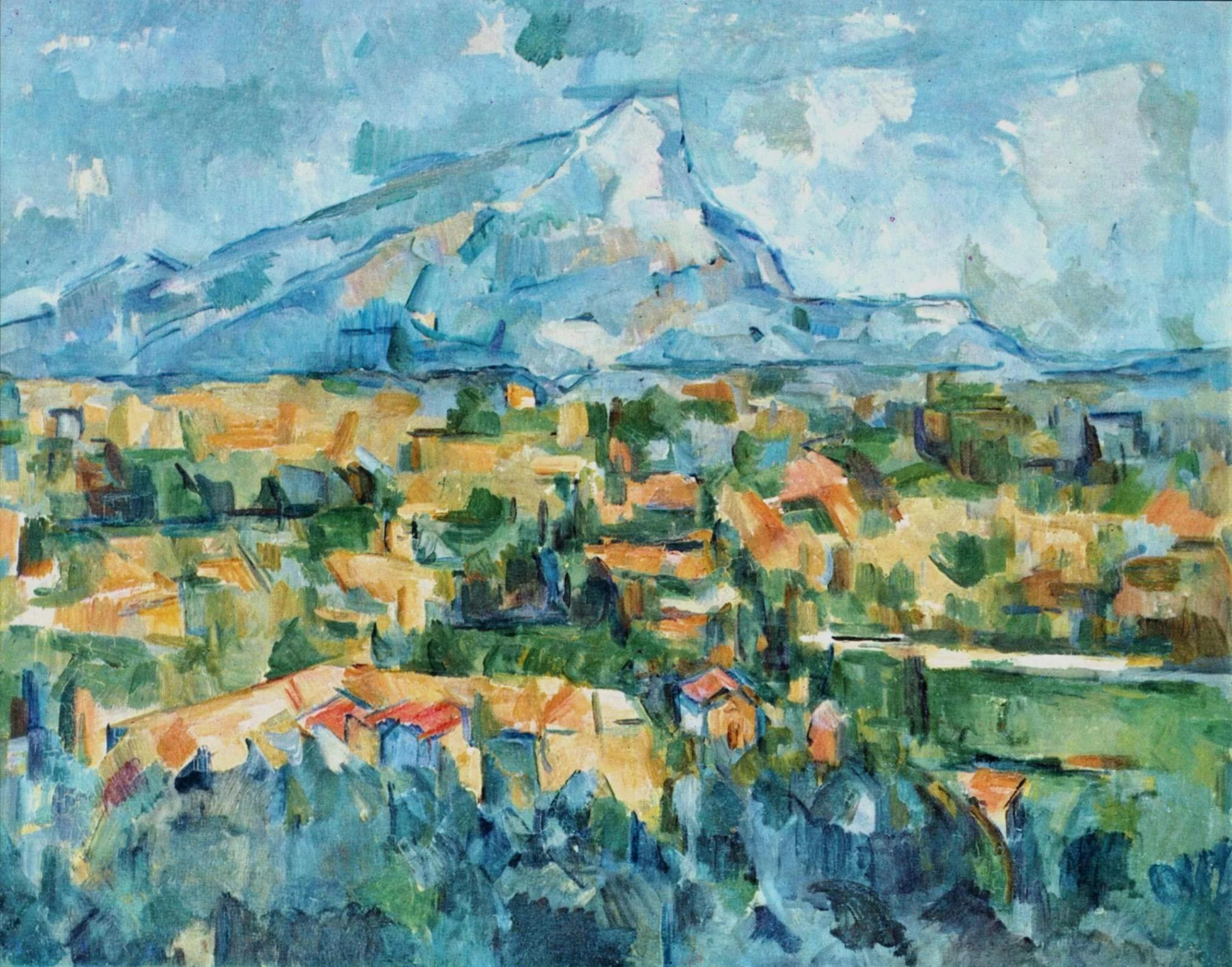
Post-Impressionism developed mainly during the 1880s and 1890s. It was not a single, unified movement. Instead, it included artists who built on Impressionism while developing individual approaches to form, color, space, and expression.
Some Post-Impressionists wanted to give paintings a stronger sense of structure. Others used color to express emotion or developed simplified forms and bold outlines. Some explored personal or spiritual subjects, while others investigated how colors could be organized according to visual principles.
Main characteristics include:
- Moving beyond Impressionism's primary focus on changing light and visual impressions.
- Greater emphasis on structure, form, and composition.
- Expressive or symbolic uses of color.
- Simplification or deliberate distortion of forms.
- Individual artistic styles rather than one shared technique.
- A stronger interest in personal experience, ideas, and emotional expression.
Paul Cézanne (1839–1906)
Paul Cézanne wanted to give painting a stronger sense of structure and permanence. Rather than simply capturing a passing visual impression, he studied the underlying forms and relationships between objects.
The Large Bathers (c. 1898–1906)
In this painting, groups of nude figures are arranged within a landscape framed by trees. The figures and trees create a carefully organized composition, with repeated triangular shapes and simplified forms.
Cézanne does not treat the bodies as isolated figures placed naturally within a landscape. Instead, he connects the figures, trees, and spaces through the overall structure of the painting.
His approach helped open new possibilities for modern art, especially for artists who wanted to construct images through simplified geometric forms.
Vincent van Gogh (1853–1890)
Vincent van Gogh used intense colors, energetic brushstrokes, and strongly simplified forms to create paintings with great emotional force. His colors and marks do not merely describe what he saw; they also contribute to the expressive character of the image.
The Starry Night (1889)
Painted while Van Gogh was staying at the Saint-Rémy asylum in France, this work depicts a village beneath a dramatic night sky. The sky is filled with swirling shapes, bright stars, and a luminous moon. A dark cypress tree rises in the foreground.
The energetic brushstrokes make the sky appear to move. The landscape is not presented as a neutral record of a place but as an expressive image shaped by the artist's individual vision.
The painting demonstrates how Post-Impressionism could use color, line, and brushwork to convey an intense personal response to the world.
Georges Seurat (1859–1891)
Georges Seurat developed a highly systematic approach to painting. He studied color theory and experimented with placing small dots or touches of color next to one another so that they would visually combine when seen from a distance.
This technique is associated with Pointillism, while his broader approach is often called Neo-Impressionism.
A Sunday Afternoon on the Island of La Grande Jatte (1884–1886)
This large painting depicts people relaxing in a park beside the Seine. The figures are arranged in a carefully ordered composition, and many appear almost still, like silhouettes.
Seurat's method contrasts with the more spontaneous brushwork often associated with Impressionism. He organized the scene through a deliberate system of small color marks, careful shapes, and repeated vertical forms.
His work shows how artists could develop a more structured and scientific approach to color while still exploring modern leisure and everyday life.
Symbolism and the realm of the subconscious
Symbolism developed during the late nineteenth century, especially in France and Belgium. Symbolist artists were interested in subjects that could suggest hidden meanings, dreams, fears, spiritual experiences, and the mysterious aspects of human existence.
Unlike Realist artists, who often focused on contemporary social life, Symbolists frequently turned toward mythology, religion, literature, fantasy, and the imagination. They did not always want to describe the visible world accurately. Instead, they used images to suggest ideas and feelings that could not be expressed directly.
Main characteristics include:
- Emphasis on imagination, dreams, and the inner world.
- Use of symbols and images with multiple possible meanings.
- Interest in mythology, religion, literature, and the supernatural.
- Mysterious, fantastical, or disturbing subjects.
- Images that suggest rather than clearly explain an idea.
- A focus on mood, psychological experience, and spiritual questions.
Symbolism was not limited to painting. It also influenced literature, poetry, graphic art, and other creative fields.
Gustave Moreau (1826–1898)
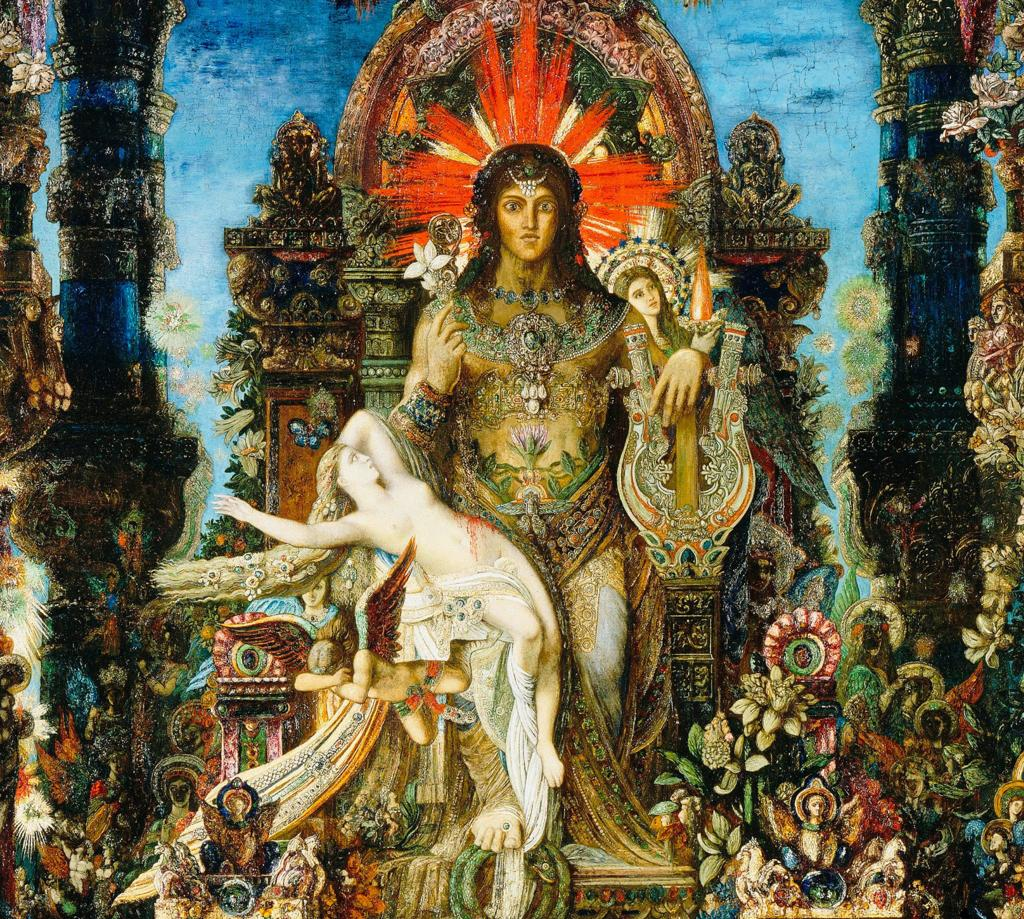
Gustave Moreau was a French Symbolist painter known for elaborate, mysterious scenes inspired by mythology and religious stories. His paintings often contain richly decorated settings, unusual details, and figures that seem to belong to an imaginary world.
The Apparition (c. 1876)
This painting depicts Salome before a vision of the severed head of John the Baptist. The head appears suspended in a radiant, supernatural light, transforming a biblical narrative into a disturbing vision.
Moreau uses elaborate decoration, dramatic imagery, and an atmosphere of mystery. The painting is not simply an illustration of a religious story; it invites the viewer into a world of obsession, desire, fear, and the supernatural.
Odilon Redon (1840–1916)
Odilon Redon created imaginative and often unsettling images inspired by dreams, literature, and the subconscious. He became known for his drawings and lithographs, in which ordinary forms could be transformed into strange and poetic visions.
The Eye, Like a Strange Balloon, Mounts Toward Infinity (1882)
This lithograph presents a giant eye rising through space like a balloon. The unexpected combination of a familiar body part and an impossible situation creates a mysterious, dreamlike image.
Redon's work does not explain its meaning in a straightforward way. Instead, the image encourages viewers to interpret it through their own associations and imagination.
Art Nouveau
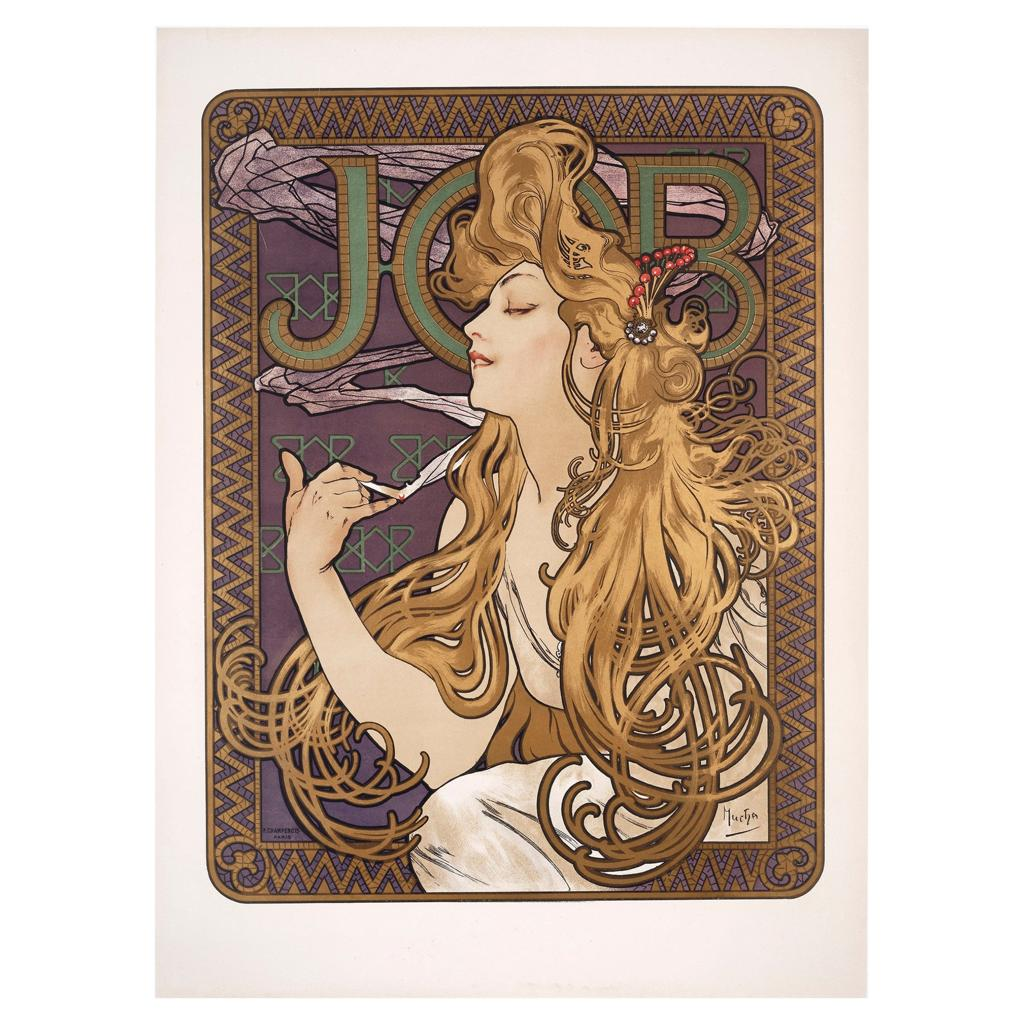
Art Nouveau emerged in the late nineteenth century and became internationally influential around 1900. Its name means “New Art.” Artists and designers sought a modern style that would move away from simply copying historical styles.
Art Nouveau is especially associated with architecture, interior decoration, furniture, posters, glass, metalwork, and other forms of applied art. It aimed to bring artistic design into everyday life.
Main characteristics include:
- Flowing, curved lines and asymmetrical compositions.
- Decorative forms inspired by plants, flowers, vines, and other natural shapes.
- Integration of structure and ornament.
- Interest in materials such as iron, glass, and wood.
- A unified design in which architecture, furniture, and decoration work together.
- The creation of a modern style rather than a direct imitation of historical architecture.
Art Nouveau was not identical in every country. Some artists favored flowing, organic forms, while others developed more geometric designs. Its central ambition was to create a distinctive modern visual language.
Victor Horta (1861–1947)
Victor Horta was a Belgian architect and one of the pioneers of Art Nouveau architecture. He used iron, glass, and decorative lines to create interiors in which structural elements and ornament formed a unified design.
Hôtel Tassel, Brussels (1892–1893)
The Hôtel Tassel is an important early example of Art Nouveau architecture. Its interior includes a staircase with flowing ironwork, plant-inspired patterns, and curved lines that extend across different surfaces.
Instead of treating decoration as something added after the building was designed, Horta integrated it into the architecture. The staircase, railings, columns, and decorative details contribute to the overall unity of the space.
Hector Guimard (1867–1942)
Hector Guimard was a French architect and designer known for the entrances he created for the Paris Métro.
Paris Métro Entrances (c. 1900)
Guimard's entrances use curved metal forms that resemble stems, branches, and other natural shapes. Their distinctive appearance makes ordinary urban infrastructure part of the city's artistic environment.
These entrances show how Art Nouveau could transform a functional object into a work of design. They also demonstrate the movement's interest in combining architecture, sculpture, and applied art.
Antoni Gaudí (1852–1926)
Antoni Gaudí was a Catalan architect whose highly individual style combined organic forms, imaginative structures, and elaborate decoration.
Casa Milà (1905–1907)
Casa Milà in Barcelona is known for its undulating stone façade, irregular forms, and sculptural appearance. The building avoids the rigid straight lines and regular symmetry typical of many traditional buildings.
Gaudí treated the building almost as a living form, allowing its surfaces and details to create a continuous, dynamic appearance. Casa Milà illustrates the more sculptural and organic possibilities of Art Nouveau architecture.
Charles Rennie Mackintosh (1868–1928)
Charles Rennie Mackintosh was a Scottish architect and designer whose work developed a more restrained and geometric approach than the flowing forms associated with some other Art Nouveau architects.
Glasgow School of Art (1896–1910)
The Glasgow School of Art combines a modern architectural design with carefully organized spaces and distinctive decorative details. Mackintosh used strong geometric forms and controlled ornament rather than covering every surface with flowing decoration.
His work demonstrates that Art Nouveau was not limited to curving, plant-like lines. The movement also included designers who sought a modern style through simplicity, geometry, and the integration of architecture and design.
Comparing the Three Developments
| Feature | Post-Impressionism |
|---|---|
| Main focus | New approaches to form, color, and composition |
| Main interests | Structure, expressive color, and personal vision |
| Common forms | Mainly painting |
| Important artists | Cézanne, Van Gogh, Gauguin, Seurat |
| Symbolism | |
|---|---|
| Ideas, dreams, emotions, and hidden meanings | |
| Imagination, mythology, spirituality, and the subconscious | |
| Painting, graphic art, and literature | |
| Moreau, Redon, Ensor |
| Art Nouveau | |
|---|---|
| Decorative design and the integration of art into everyday life | |
| Nature-inspired forms, flowing lines, architecture, and applied art | |
| Architecture, interiors, furniture, posters, objects | |
| Horta, Guimard, Gaudí, Mackintosh |
Key terms
-
Post-Impressionism: A broad term for different artistic approaches that developed beyond Impressionism.
-
Neo-Impressionism: An approach associated with systematic color relationships and carefully organized brushstrokes.
-
Pointillism: A technique using small dots or touches of color placed next to one another.
-
Symbolism: An artistic movement that uses images to suggest ideas, dreams, emotions, and hidden meanings.
-
Symbol: An image or object that represents an idea beyond its literal appearance.
-
Art Nouveau: An international decorative style that developed in the late nineteenth century.
-
Applied art: Art and design used in functional objects and everyday environments.
-
Organic forms: Shapes inspired by living things and natural growth.
-
Composition: The arrangement of forms, figures, colors, and spaces within an artwork.
Create Your Own Website With Webador