Early Renaissance in Italy
Historical context: Humanism and linear perspective
The Renaissance was a period of cultural and artistic change that began in Italy during the fourteenth century and gradually spread throughout Europe. The word Renaissance means “rebirth.” Artists and scholars became interested in the art, literature, philosophy, and architecture of ancient Greece and Rome.
Florence became one of the most important centres of the Early Renaissance. The city was wealthy because of trade, banking, and textile production. Wealthy families, religious institutions, and civic authorities supported artists by paying them to create works of art. This support is known as patronage. One of the most powerful families was the Medici family, whose wealth and political influence helped shape the cultural life of Florence. Cosimo de’ Medici (1389–1464) strengthened the family's position during the first half of the fifteenth century. Later, Lorenzo de’ Medici (1449–1492), known as Lorenzo the Magnificent, became an important patron of artists, writers, and scholars.
Another important influence was humanism, an intellectual movement that emphasised classical learning, human abilities, education, and individual experience. Religion remained central to Renaissance life, but artists increasingly explored the human body, emotions, nature, and the physical world.
The Early Renaissance developed mainly during the fifteenth century. Artists did not simply copy ancient Greek and Roman works. They studied classical art and combined its principles with new approaches to observation, anatomy, and the representation of space.


Main Characteristics of Early Renaissance Art
Early Renaissance artists wanted to represent the world in a more naturalistic and convincing way. They studied the human body, nature, mathematics, and the principles of perspective to make figures and spaces appear more realistic.
Linear perspective was an important development in Renaissance painting. It created the illusion of three-dimensional space on a flat surface by making parallel lines appear to converge at a single point, called the vanishing point.
Proportion also became important. Artists paid attention to the relationships between the sizes of different parts of a figure or building, aiming to create balanced and harmonious compositions.
Figures became more solid and three-dimensional, with greater attention to anatomy, natural movement, light, and shadow. In sculpture, artists drew inspiration from the human figures of ancient Greek and Roman art.
However, medieval traditions did not disappear immediately. Religious subjects remained common, and Gothic features continued to appear in some works. The Early Renaissance was a period of gradual change rather than a sudden break with the past.
Architecture
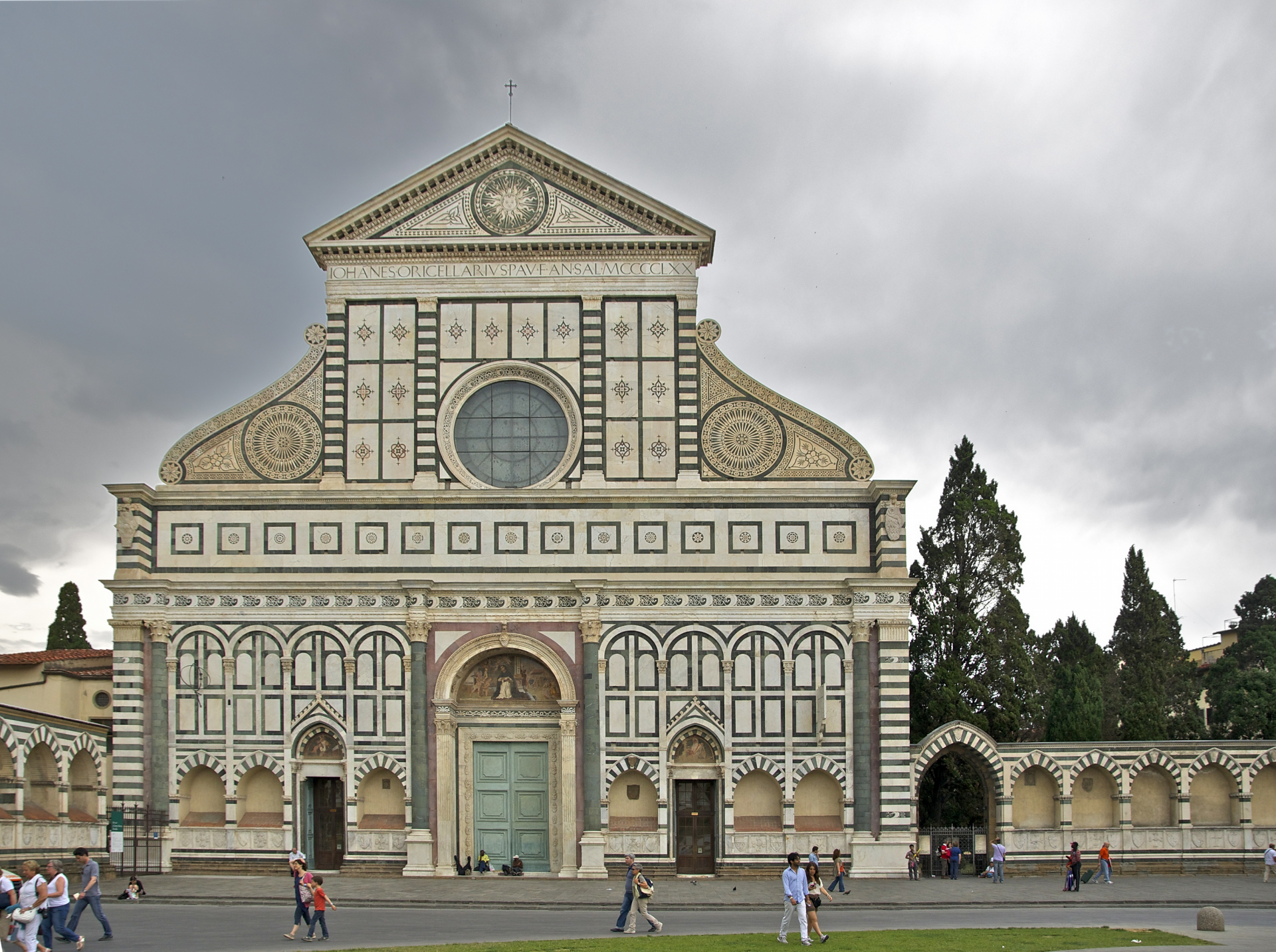
Renaissance architects looked to ancient Roman buildings for inspiration. They used geometric forms, symmetry, rounded arches, columns, and carefully calculated proportions to create balanced and harmonious structures.
Filippo Brunelleschi (1377–1446)
Filippo Brunelleschi was one of the most important architects of the Early Renaissance. He studied ancient Roman architecture and applied mathematical principles to architectural design.
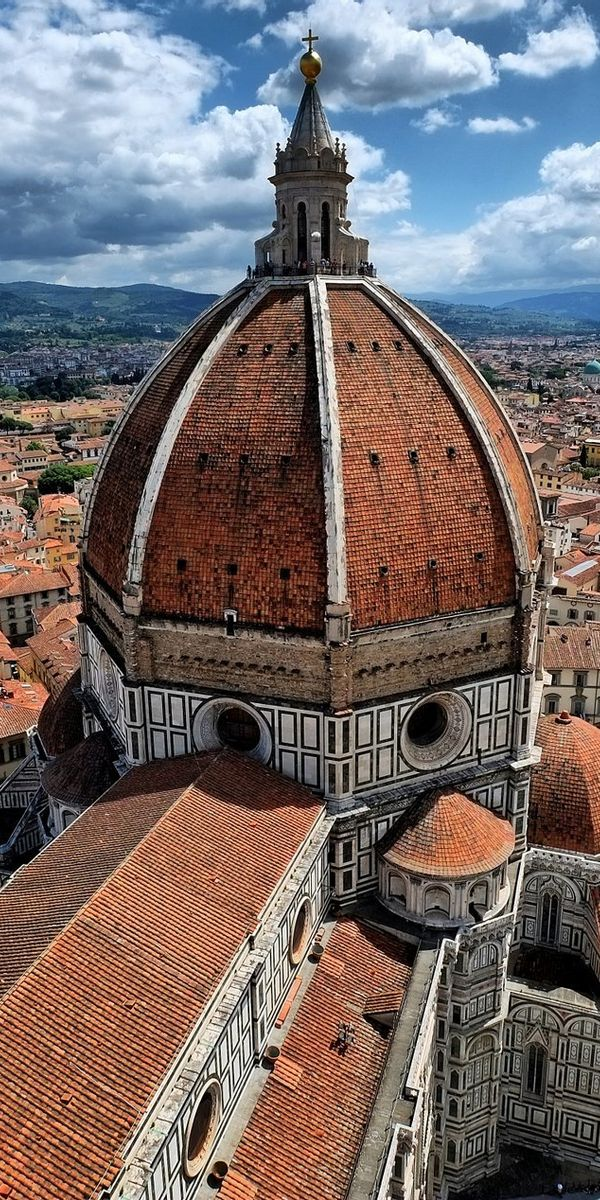
His greatest achievement was the dome of Florence Cathedral, completed in 1436. The dome was a major engineering achievement and became a symbol of Florence. Brunelleschi developed innovative construction methods to build the enormous dome without traditional external wooden supports.
Another important building associated with Brunelleschi is San Lorenzo in Florence. Its columns, rounded arches, and carefully proportioned interior reflect the renewed interest in classical architecture.
Leon Battista Alberti (1404–1472)
Leon Battista Alberti was an architect and writer who helped develop and spread Renaissance architectural ideas. He studied classical buildings and emphasised mathematical relationships, symmetry, proportion, and harmony.
Alberti also wrote about art and architecture, helping artists understand the principles behind their work. His writings contributed to the spread of Renaissance ideas beyond Florence.
Sculpture in the Early Renaissance
Early Renaissance sculptors studied ancient Greek and Roman statues to understand human anatomy, natural movement, and the proportions of the human body. Their sculptures often showed figures with a stronger sense of physical presence and individual character.
Donatello (c. 1386–1466)
Donatello was one of the most influential sculptors of the Early Renaissance. He explored realistic anatomy, natural poses, and the influence of classical sculpture.
His bronze statue David represents the biblical hero after his victory over Goliath. The nude male figure reflects the renewed interest in the human body found in ancient classical art. Its relaxed pose and natural proportions distinguish it from many medieval sculptures.
Another important work is Saint George, created for the church of Orsanmichele in Florence. The figure appears alert and confident, with a strong physical presence.
Lorenzo Ghiberti (1378–1455)
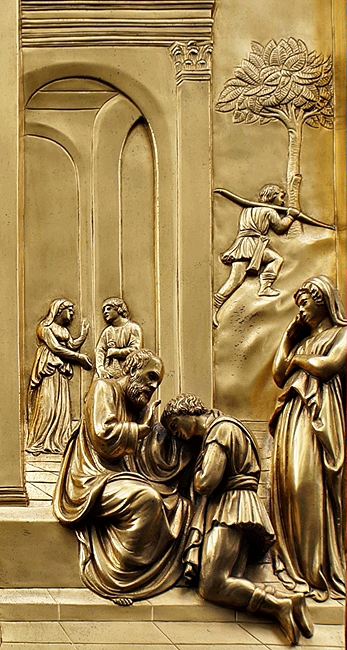
Lorenzo Ghiberti was a sculptor best known for the bronze doors of the Florence Baptistery. His later doors, known as the Gates of Paradise, contain ten large relief panels illustrating biblical stories.
Ghiberti created an illusion of depth by varying the relief. Figures and objects in the foreground project more strongly from the surface, while distant figures and buildings are carved more shallowly. This technique makes the scenes appear more spacious and realistic.
Painting
Early Renaissance painters aimed to represent figures and spaces more realistically. They used linear perspective, light and shadow, and careful observation to create a convincing sense of depth and volume. They also paid greater attention to human emotions and physical presence.
Masaccio (1401–1428)
Masaccio was one of the most important painters of the Early Renaissance. Although he died young, his use of perspective, realistic figures, and light and shadow had a lasting influence on later artists.
The Holy Trinity (c. 1425–1427)
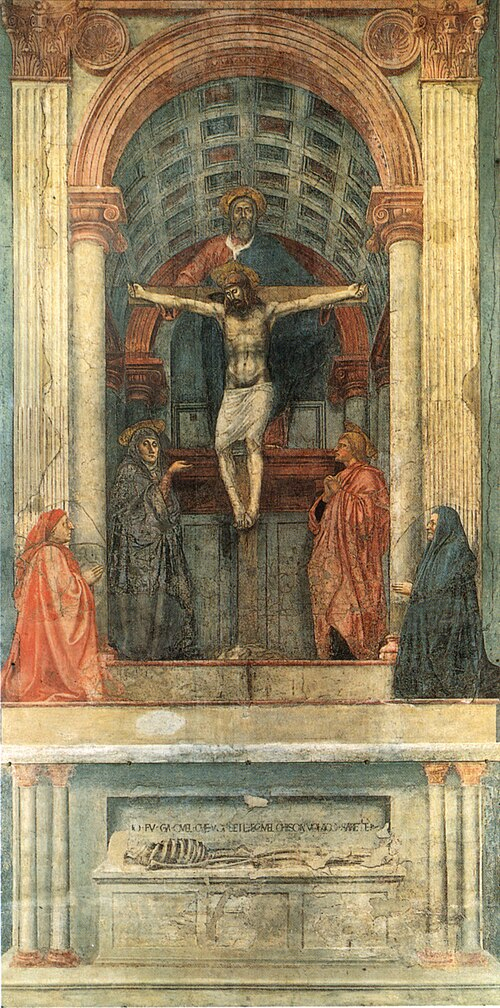
Located in the church of Santa Maria Novella in Florence, The Holy Trinity is famous for its use of linear perspective. Masaccio created the illusion of a deep architectural space on a flat wall, making the painted structure appear three-dimensional.
The Tribute Money (c. 1425)
Painted in the Brancacci Chapel in Florence, The Tribute Money depicts a story from the life of Christ. Masaccio used solid, three-dimensional figures, realistic expressions, and light and shadow to give the figures a convincing physical presence.
The painting also shows several moments of the same biblical story within a single composition. Its realistic figures and carefully constructed space helped establish new approaches to Renaissance painting.
Revolutionary painting, key vocabulary, and review
Key vocabulary
-
Renaissance: A period of cultural and artistic renewal inspired by ancient Greek and Roman culture.
-
Humanism: An intellectual movement that emphasised classical learning, human abilities, and individual experience.
-
Patronage: Financial support given to artists by wealthy individuals, religious institutions, or civic authorities.
-
Linear Perspective: A technique used to create the illusion of three-dimensional space on a flat surface.
-
Proportion: The relationship between the sizes of different parts of a figure or structure.
-
Naturalism: The attempt to represent people, objects, and nature in a realistic way.
-
Fresco: A painting technique in which pigments are applied to wet plaster.
-
Relief Sculpture: Sculpture in which figures project from a flat background.
Knowledge check: Early Renaissance in Italy
Test your understanding of the key concepts, artists, and revolutionary techniques of the Italian Early Renaissance. Expand each question below to reveal the answer.
Create Your Own Website With Webador