Early Christian and Byzantine art
Historical context
Early Christian and Byzantine art developed as Christianity transformed the Roman world. Artists adapted Roman artistic techniques and architectural forms to express Christian beliefs, creating new ways to represent religious stories, sacred figures, and spiritual ideas. Early Christian art focused on communicating faith, salvation, and eternal life. Byzantine art developed this tradition further, becoming known for monumental churches, symbolic figures, and brilliant mosaics.
Although these traditions share common roots, they developed distinctive visual characteristics that reflect the changing role of Christianity in society.
The Rise of Christianity
Early Christian art developed during the first centuries of Christianity in the Roman Empire. At first, Christians were a minority and sometimes faced persecution.
An important turning point came in AD 313, when Emperor Constantine issued the Edict of Milan, allowing Christians to practice their religion openly. Later, Christianity became the official religion of the Roman Empire. These changes transformed art and architecture. Christians needed larger buildings for public worship and images that could communicate religious stories and beliefs. Unlike much ancient Greek and Roman art, which often emphasized the human body, ideal beauty, and the natural world, Christian art increasingly focused on spiritual meaning and the teachings of the Bible.
After the Roman Empire was divided, its eastern part continued as the Byzantine Empire, with Constantinople as its capital. Byzantine art developed from Roman traditions but became known for its distinctive religious imagery, monumental architecture, and brilliant mosaics.


Early Christian Art
Early Christian Painting and Symbols
Before Christianity was officially accepted, Christians often gathered and buried their dead in underground burial places called catacombs. The walls of these burial spaces were decorated with paintings of biblical figures and scenes.
Early Christian artists used familiar Roman artistic techniques but gave traditional images new Christian meanings.
One important example is the Good Shepherd, a figure representing Christ as a protector who cares for humanity. Other common subjects included the story of Jonah and figures called orants, shown praying with their arms raised.
These images communicated ideas about faith, salvation, and life after death. They were not simply decorative; they helped express the beliefs of the early Christian community.
Early Christian Architecture
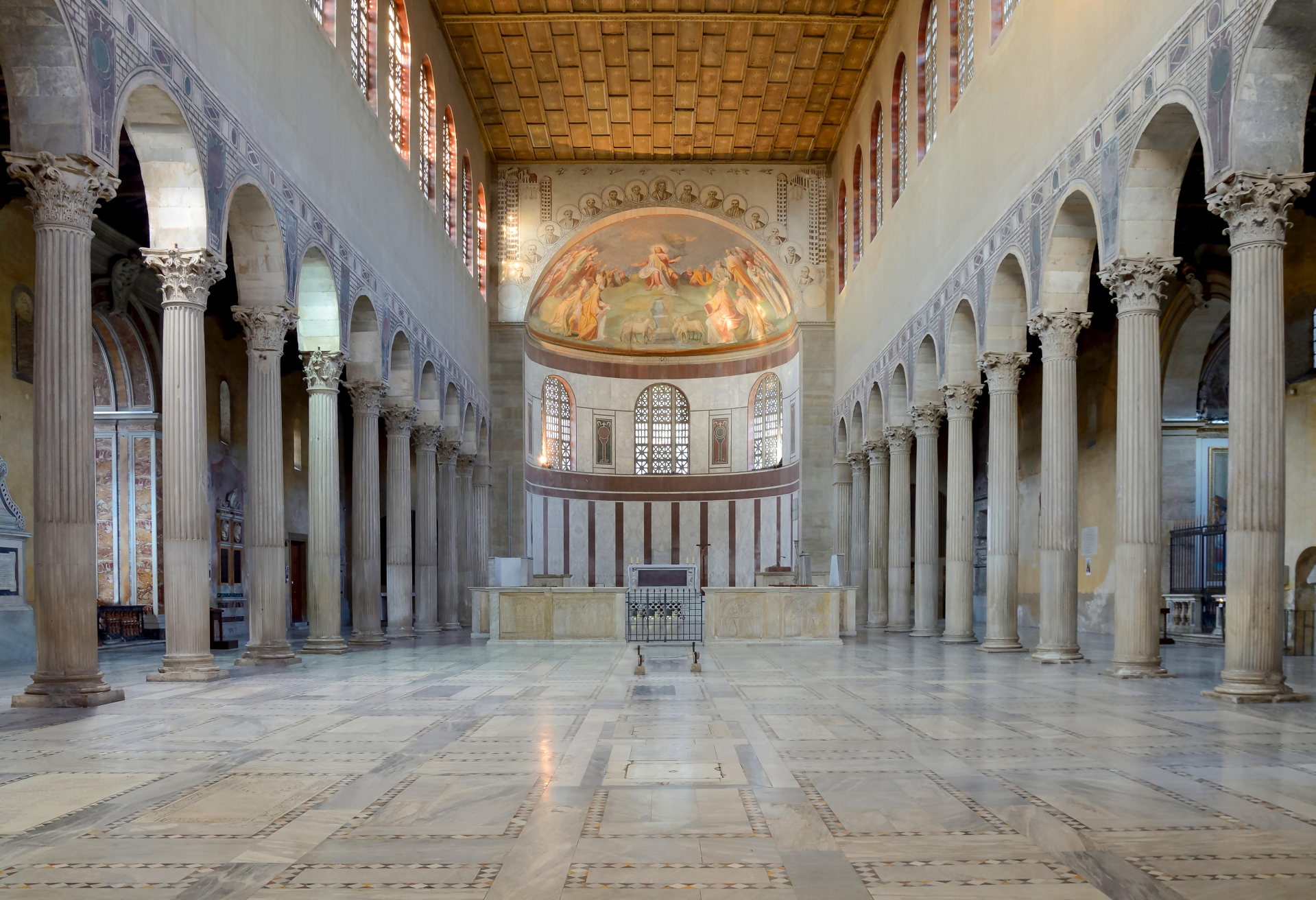
After Christianity became legal, Christians needed larger buildings where entire communities could gather for worship. They adapted the Roman basilica, a large public building originally used for civic and administrative purposes.
A typical Christian basilica included:
-
Nave: The central space where the congregation gathered.
-
Side aisles: Narrower spaces running alongside the nave, usually separated by rows of columns.
-
Apse: A semicircular or polygonal space at one end, often containing the altar.
-
Rows of columns: Architectural elements separating the central nave from the side aisles.
This layout created a large interior space suitable for Christian ceremonies.
Two important examples are Old St. Peter’s Basilica in Rome, built during the reign of Constantine, and Santa Sabina, a fifth-century church in Rome.
Unlike a Roman temple, which was primarily designed for religious rituals associated with a deity, the Christian basilica provided an interior space where the Christian community could gather and worship together.
Main Idea: Early Christian art adapted Roman artistic forms and architecture to communicate Christian beliefs, while the Christian basilica created a practical space for communal worship.
Byzantine Art
Byzantine art developed in the eastern part of the Roman Empire and continued for many centuries. Its most important center was Constantinople, founded by Constantine on the site of the ancient city of Byzantium.
The reign of Emperor Justinian I, from 527 to 565, was an especially important period. Justinian sought to strengthen the empire and restore Roman power. His building projects and the decoration of churches demonstrated the close relationship between the emperor, the Church, and the Christian faith.
Hagia Sophia
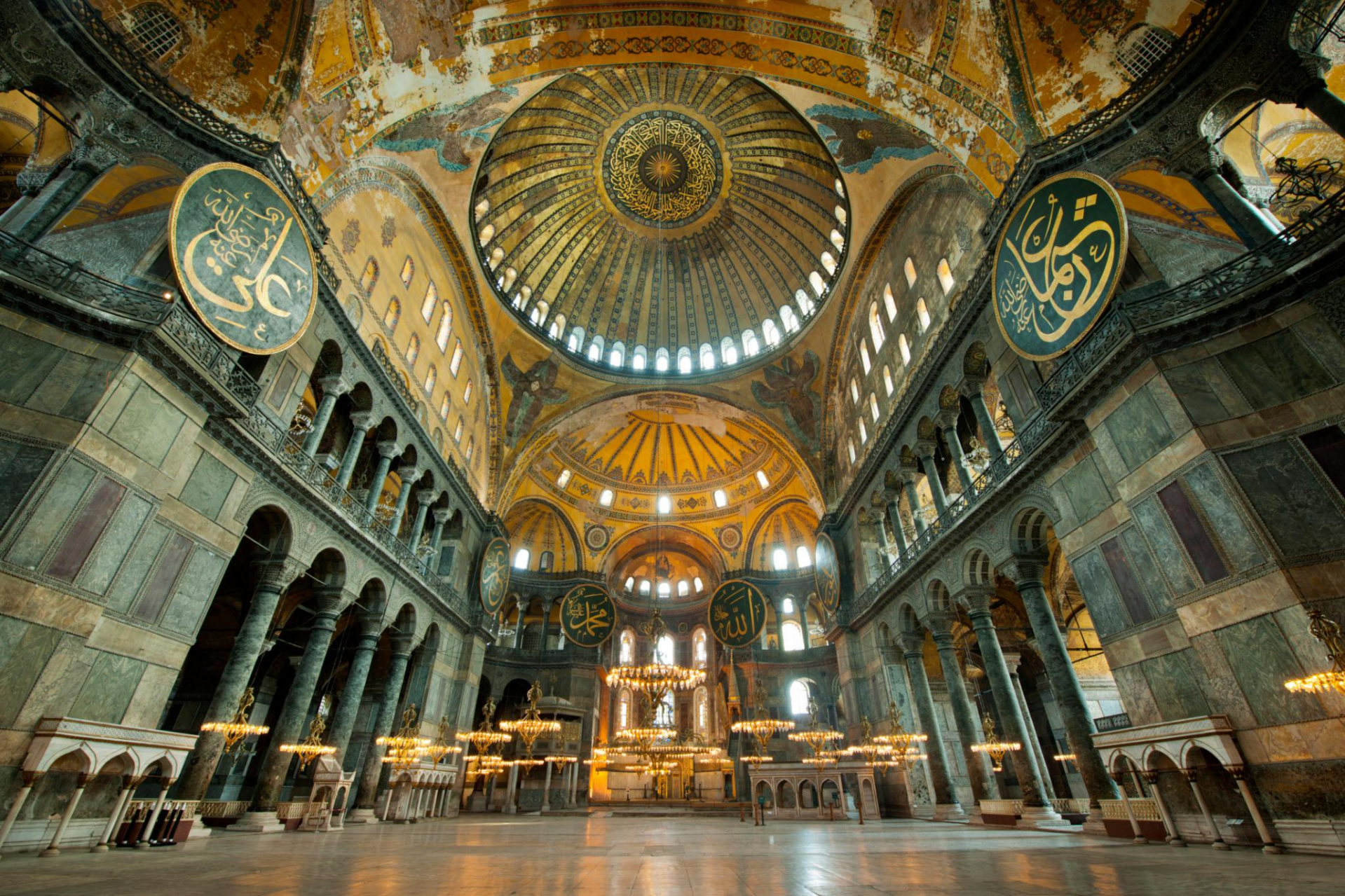
One of the greatest achievements of Byzantine architecture is Hagia Sophia in Constantinople, now Istanbul. The present building was constructed during the reign of Justinian and consecrated in AD 537.
Designed by Anthemius of Tralles and Isidore of Miletus, Hagia Sophia combines a large central dome with elements of the basilica plan. The dome appears to float above the interior, supported by an innovative system of arches and pendentives.
The enormous interior, marble surfaces, and light entering through the windows created an impressive spiritual experience. Hagia Sophia demonstrates how Byzantine architects combined Roman engineering traditions with new architectural solutions.
Byzantine Mosaics
Mosaics were among the most important forms of Byzantine art. Artists arranged small pieces of colored glass, stone, or other materials to create images on walls and ceilings. Gold backgrounds reflected light and gave the scenes a radiant, otherworldly appearance.
Byzantine figures are often frontal, formal, and arranged in a clear hierarchy. Their bodies may appear flat, and their movements are limited. These features were not necessarily mistakes in drawing. They helped communicate spiritual importance rather than ordinary physical reality.
San Vitale in Ravenna
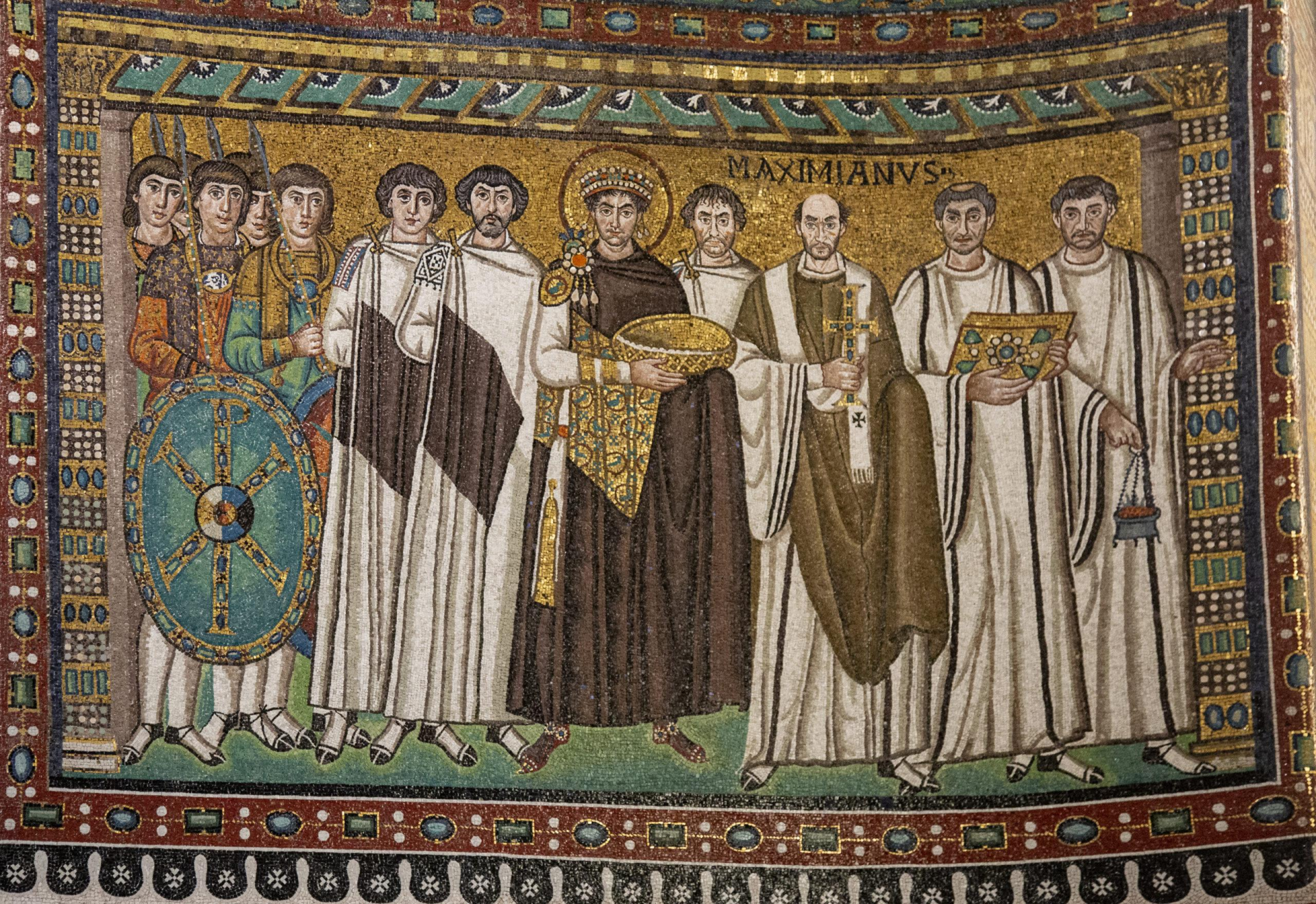
The Church of San Vitale in Ravenna, Italy, is one of the most important examples of Byzantine art in the West. Built in the sixth century, it contains famous mosaics showing Emperor Justinian and Empress Theodora with members of their courts.
The figures are presented frontally and stand in a solemn, ceremonial arrangement. Their rich clothing, halos, and the gold background emphasize their status and their connection to the Christian Church. The mosaics also communicate the close relationship between imperial authority and religious power.
Main Characteristics of Early Christian and Byzantine Art
Early Christian art adapted Roman forms and techniques to express Christian beliefs. It used biblical stories and symbols to communicate ideas about Christ, salvation, and eternal life.
Byzantine art developed a more formal and symbolic visual language. Its major characteristics include:
-
Religious subjects drawn from the Bible and Christian tradition.
-
Frontal figures and formal compositions.
-
Gold backgrounds and richly colored mosaics.
-
Less emphasis on naturalistic depth and realistic anatomy.
-
The use of images to communicate spiritual meaning.
-
Monumental church architecture, including domes and richly decorated interiors.
Key terms
- Catacombs: Subterranean networks of rock-cut galleries and chambers used as communal cemeteries and clandestine worship spaces by early Christians in imperial Rome.
- Orant: A stylized figure depicted frontally with outstretched, upturned arms in a traditional posture of prayer and supplication.
- Good Shepherd: An early allegorical depiction of Jesus Christ represented as a youthful, humble shepherd carrying a lamb, symbolizing pastoral care and spiritual redemption.
-
Basilica – a large rectangular building type adapted by Christians for worship.
-
Nave – the central space of a church.
-
Apse – a semicircular or polygonal space, often at the end of a church, where the altar may be placed.
-
Mosaic – an image made from small pieces of colored stone, glass, or other materials.
-
Pendentive – a curved architectural section that helps support a dome over a square space.
-
Icon – a sacred image, especially one depicting Christ, the Virgin Mary, or saints.
-
Frontal representation – a figure shown facing directly toward the viewer.
- Edict of Milan: The landmark proclamation issued by Emperor Constantine in AD 313 establishing religious tolerance throughout the Roman Empire and officially legalizing Christian worship.
Create Your Own Website With Webador