Neoclassicism and Romanticism
Historical context


During the eighteenth century, European society experienced major intellectual, political, and social changes. The Enlightenment encouraged people to use reason, observation, and scientific thinking rather than accept traditional authority without question. Archaeological discoveries at Pompeii and Herculaneum renewed interest in the art and architecture of ancient Greece and Rome.
At the same time, political and social tensions challenged the traditional power of monarchies and aristocratic elites. The American Revolution and the French Revolution raised questions about liberty, citizenship, equality, and political authority.
These changes influenced art. Two important movements emerged: Neoclassicism, which emphasized order, reason, and the ideals of classical antiquity, and Romanticism, which emphasized emotion, imagination, individuality, and the power of nature.
The two movements overlapped in time, and not every artist followed only one style. However, they often expressed different ideas about human beings, society, and the world.
Left: Salon of Madame Geoffrin; Excavations of Pompeii
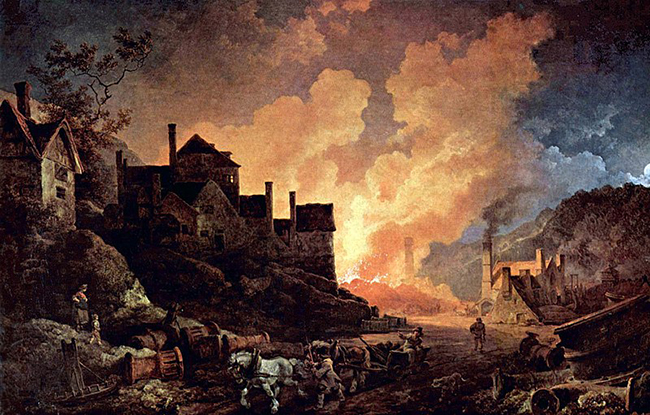
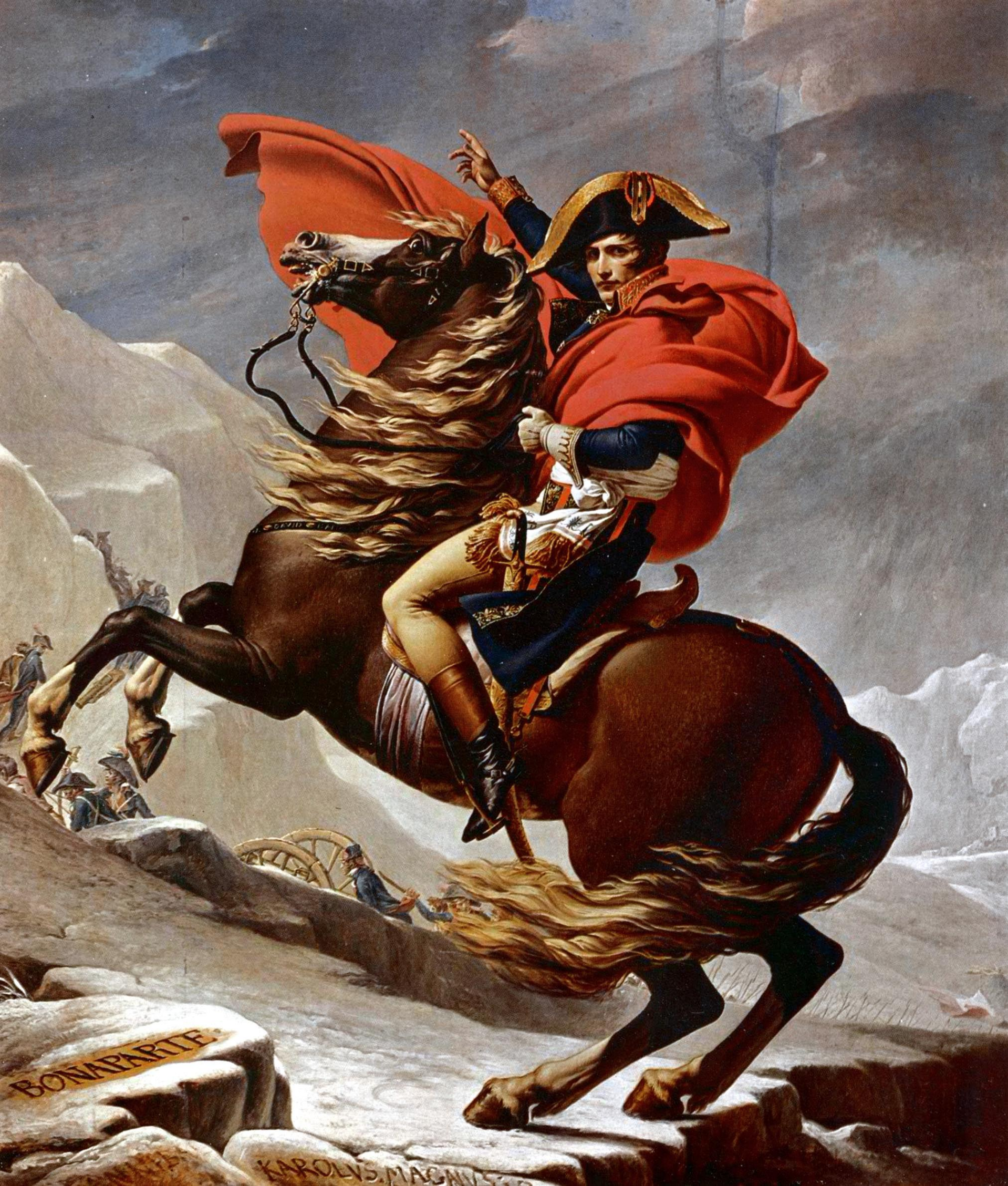
Right: Storming of the Bastille; Declaration of Independence; Coronation of Napoleon; Coalbrookdale by Night


Neoclassicism
Historical context: Inspired by the Enlightenment, archaeological discoveries at Pompeii, and the ideals of the French Revolution, Neoclassicism rejected Rococo frivolity in favor of moral clarity, restraint, and stoic heroism.
Main characteristics of Neoclassical art include:
- Inspiration from ancient Greek and Roman art.
- Clear, balanced, and carefully organized compositions.
- Firm outlines and controlled gestures.
- Figures with idealized forms and references to classical sculpture.
- Historical and mythological subjects.
- Moral and political messages emphasizing duty, virtue, and sacrifice.
Neoclassicism was not simply an attempt to copy ancient art. Artists used classical models to address the political and moral concerns of their own time.
Jacques-Louis David
Jacques-Louis David was one of the leading painters of Neoclassicism in France. His paintings often presented historical subjects as examples of civic duty, patriotism, and sacrifice.
The Oath of the Horatii (1784)
This painting depicts a story from ancient Roman history. Three brothers swear an oath to their father, pledging to fight for Rome. Their firm poses, extended arms, and clear arrangement emphasize determination and duty. The figures are organized into a balanced composition, with strong outlines and architectural arches separating the groups.
The painting became an important example of Neoclassical art because it presents personal sacrifice for the state as a moral ideal.
The Death of Marat (1793)
David painted this work during the French Revolution. It depicts the revolutionary leader Jean-Paul Marat after his assassination. Rather than showing the scene with excessive detail or dramatic movement, David uses a simple composition, restrained background, and carefully arranged body to present Marat as a martyr of the Revolution.
The painting demonstrates how Neoclassical clarity and seriousness could be used to communicate contemporary political ideas, not just stories from antiquity.
Antonio Canova
Antonio Canova was an Italian sculptor associated with Neoclassicism. He studied ancient sculpture and sought ideal beauty through smooth surfaces, balanced proportions, and controlled poses.
Psyche Revived by Cupid’s Kiss (1787–1793)
This marble sculpture depicts Cupid embracing Psyche and reviving her with a kiss. Although the subject comes from classical mythology, Canova presents it with refined forms, graceful movement, and idealized beauty. The intertwined bodies create a carefully balanced composition.
The sculpture shows how Neoclassical artists adapted classical ideals to subjects involving love and emotion.
Jean-Auguste-Dominique Ingres
Jean-Auguste-Dominique Ingres continued the Neoclassical tradition into the nineteenth century. He emphasized precise drawing, clear contours, and carefully finished surfaces.
Grande Odalisque (1814)
This painting depicts a reclining woman in an imagined Eastern setting. Ingres emphasizes the smooth surface, elegant contour, and elongated body. The unusual proportions show that the artist sometimes adjusted anatomy to create a flowing, idealized form.
The painting is useful for understanding how Neoclassical artists valued line and controlled design, even when they departed from strict anatomical realism.
Romanticism
Historical context: Romanticism developed around the late eighteenth and early nineteenth centuries. It emerged partly in reaction to the emphasis on reason, order, and universal rules associated with the Enlightenment and Neoclassicism.
Romantic artists explored intense emotions, imagination, individual experience, dramatic historical events, and the power of nature. They were interested in subjects that could inspire awe, fear, wonder, or sympathy.
Main characteristics of Romantic art include:
- Emphasis on emotion, imagination, and individual experience.
- Dramatic scenes and dynamic compositions.
- Powerful natural forces, including storms, mountains, and the sea.
- Interest in history, revolution, freedom, and national identity.
- Strong contrasts of light and color.
- Subjects involving suffering, heroism, fear, or the sublime.
The concept of the sublime is especially important in Romanticism. It describes an experience of awe mixed with fear or wonder when confronted with something vast or powerful, such as a storm, a mountain range, or the open sea.
Romanticism did not reject reason in every form. Instead, it emphasized aspects of human experience that could not be explained by reason alone.
Francisco Goya
Francisco Goya was a Spanish painter and printmaker whose work explored human suffering, violence, fear, and the abuses of power. His art moved beyond traditional court portraiture and often presented a disturbing view of society.
The Third of May 1808 (1814)
This painting depicts the execution of Spanish civilians by French soldiers during the Peninsular War. A central figure in a white shirt raises his arms while facing the firing squad. The soldiers appear as a rigid, anonymous group, while the victims display fear and desperation.
The dramatic lighting, emotional gestures, and contrast between the victims and soldiers make the violence immediate. The painting condemns war and emphasizes the suffering of ordinary people.
Goya's work shows how Romantic art could use emotional intensity to confront political violence and human cruelty.
Théodore Géricault
Théodore Géricault was a French Romantic painter who often explored dramatic subjects and extreme human experiences.
The Raft of the Medusa (1818–1819)
This painting represents survivors of a shipwreck who struggle for rescue on a makeshift raft. The scene was based on a contemporary disaster that became a political scandal in France.
Géricault arranges the figures in a dramatic rising composition, leading the viewer's eye from the dead and dying in the foreground toward the figures signaling to a distant ship. The bodies, gestures, and expressions communicate despair, hope, and desperation.
Unlike a Neoclassical painting that might present a controlled moral example, this work emphasizes uncertainty, suffering, and the limits of human control.
Eugène Delacroix
Eugène Delacroix was one of the leading French Romantic painters. His art is known for expressive color, energetic brushwork, dramatic movement, and subjects involving history, revolution, and freedom.
Liberty Leading the People (1830)
This painting commemorates the July Revolution of 1830 in France. A symbolic female figure representing Liberty leads people from different social groups over a barricade. She carries the French tricolor flag and advances through a scene of conflict.
The composition is dynamic, with diagonal movements, strong contrasts, and vivid colors. The painting combines a real historical event with an allegorical figure, turning the revolution into a symbol of the struggle for freedom.
Delacroix demonstrates how Romanticism could unite political events with emotion, symbolism, and dramatic visual expression.
Caspar David Friedrich
Caspar David Friedrich was a German Romantic painter especially known for landscapes that suggest spiritual reflection and the power of nature.
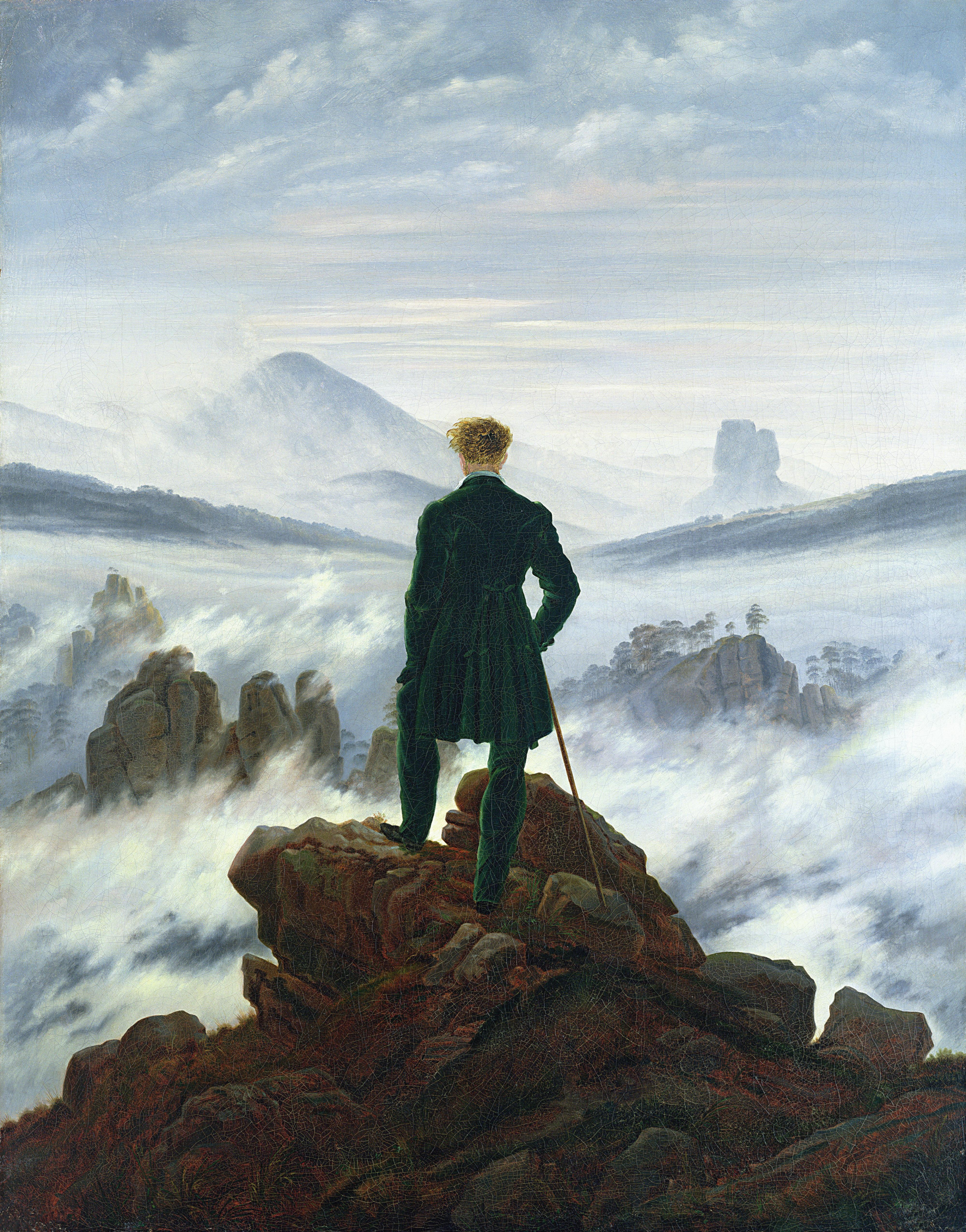
Wanderer above the Sea of Fog (c. 1818)
A man stands on a rocky peak, looking out over a vast landscape covered in mist. The viewer sees the figure from behind, sharing his view of the scene but not knowing exactly what he is thinking.
The small human figure contrasts with the immense landscape. The fog obscures the distance and creates a sense of mystery. Nature becomes a setting for reflection on human existence, uncertainty, and the limits of knowledge.
This painting is a clear example of the Romantic interest in the sublime.
J. M. W. Turner
J. M. William Turner was a British painter who explored light, atmosphere, weather, and the force of nature. His paintings often use swirling movement and dramatic color to make landscapes and seascapes feel unstable and powerful.
The Slave Ship (1840)
The painting depicts a ship in a stormy sea, with human suffering connected to the transatlantic slave trade. Turner uses turbulent waves, intense colors, and a dramatic sky to overwhelm the viewer with the violence of the scene.
The painting demonstrates the Romantic fascination with nature's power while also confronting a human tragedy.
Neoclassicism and Romanticism: Main Differences
| Neoclassicism | Romanticism |
|---|---|
| Emphasizes reason, order, and clarity | Emphasizes emotion, imagination, and individuality |
| Draws inspiration from ancient Greece and Rome | Draws inspiration from nature, history, folklore, and contemporary events |
| Often uses balanced, controlled compositions | Often uses dynamic, dramatic compositions |
| Values firm outlines and carefully defined forms | Often emphasizes expressive color, light, and movement |
| Frequently presents duty, virtue, and civic sacrifice | Frequently explores freedom, suffering, the sublime, and individual experience |
These are general differences rather than absolute rules. Both movements could address political events, historical subjects, and powerful emotions, but they often approached them in different ways.
Key terms
- Neoclassicism – An artistic movement inspired by the art and ideals of ancient Greece and Rome.
- Romanticism – An artistic movement emphasizing emotion, imagination, individuality, and the power of nature.
- Enlightenment – An intellectual movement that emphasized reason, observation, and critical thinking.
- Classical antiquity – The civilizations and artistic traditions of ancient Greece and Rome.
- Allegory – An image or story in which figures and events represent abstract ideas.
- The sublime – An experience of awe, fear, or wonder in response to something vast or powerful.
- Composition – The arrangement of figures, objects, shapes, and spaces within an artwork.
- Contour – The outline or edge that defines a form.
- Orientalism: The Romantic fascination with, and artistic depiction of, North African and Middle Eastern cultures, often romanticized through exotic narratives and vivid color.
Review quiz and self-study questions
Test your understanding of the key contrasts, core philosophies, and representative masterpieces of Neoclassicism and Romanticism. Click each question to reveal the comprehensive answer.
Create Your Own Website With Webador